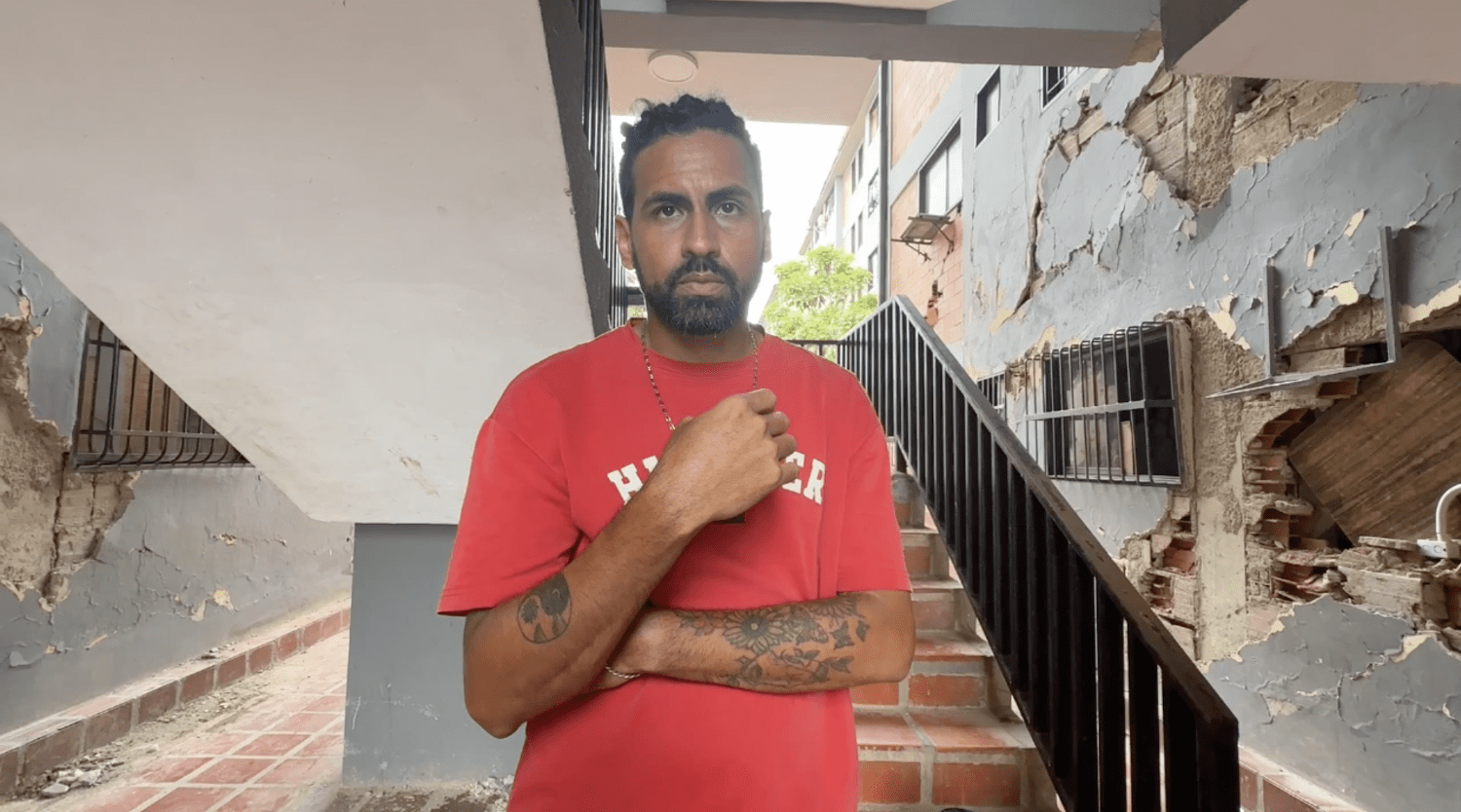
LA GUAIRA, Venezuela — A month has passed since earthquakes shook Venezuela and killed thousands, but the state of La Guaira still feels like a distant memory. Walking through a residential area is like passing through a graveyard of buildings you no longer recognize, even if you’ve lived there for years. And then there’s another reality affecting the state: the displaced. Hundreds of people are now living in donated tents after losing their homes. Some still hope the government will help them recover what they’ve lost. Others just want someone to tell them their house can be habitable again. This is the case at the Brisas de Maiquetía housing development, located directly across from the international airport serving Caracas. It’s a residential complex built under the Great Housing Mission, the state program created by the late President Hugo Chávez in 2011 to provide social housing to low-income individuals and disaster victims. Upon entering, one observes a sea of white and blue tarps beneath the once habitable buildings. Ray Cazorla, a local resident who has lived there for almost 16 years, says the situation is getting worse every day and that the help that has arrived is extremely scarce. “International aid is not being allowed to pass through here or it is not actually arriving [...] I saw publications showing a truck here with international boxes that were never delivered, it was a lie,” Cazorla told Noticias Telemundo. The problem intensifies upon entering the tents. The heat, humidity, and steam make it impossible to stay inside. “We barely manage to survive like this. We survive thanks to fans that we had to connect to the power poles, with wiring that we installed ourselves,” Cazorla added. Previously, residents slept in tents outside the housing complex, but when interim governor Delcy Rodríguez visited the area on July 15 to inspect the relief efforts, they were told they had to return to the complex and live in the donated tents. Inside, there are only bunk beds provided where an entire family sleeps. Everything else — refrigerators, stoves, gas cylinders, even portable air conditioners— families have had to try to take from their apartments. Cazorla explained that he has not been able to remove anything from his house because following the earthquake the stairs are badly cracked and he fears that if he moves any heavy appliances, the staircase will give way completely. According to him, the engineers who inspected the buildings said they have no structural problems, only issues with the masonry and brickwork. He doesn’t believe them. “One of the towers has a broken main beam,” Cazorla said. “I don’t know if they’re going to repair it, but all the apartments are like that.” Residents say that drinking water doesn’t reach the area. That’s why there are drinking water tanks with filters at various points throughout the development. They weren’t installed by the government, but by the Cadena Foundation, a humanitarian organization of the global Jewish community. The filtration system, however, has flaws: filling a five-liter pot can take a whole day, since the process works drop by drop. The remaining tanks — many salvaged from the ruins themselves — are filled with water from the street. Residents say it’s yellow water, unfit for drinking. They only use it for bathing and cooking. “Every day we feel more alone. The first day the government arrived with a huge crowd, a real commotion, because we thought they were going to make the process quick,” Cazorla said. Hopes faded when in the following days, he said, no one from from the government showed up and the neighbors were left alone, taking care of their homes and waiting in tents for the nightmare to pass. The Venezuelan interim government assured them that they could return to their apartments by March 2027. The news wasn’t well received, although some have already resigned themselves to the idea that this tent will be their home for many months. “We’re going to be here for several months; we’re all living on the floor because nobody wants to leave their apartment for fear of having their few valuables stolen,” one person pointed out. Some people have decorated the entrance to their tents with potted plants, flowers, and family mementos. Others are putting cement underneath them so the soil won’t bother them as much. Brisas de Maiquetía has not been spared from looting, a problem affecting all of La Guaira. Some buildings have messages painted on their walls: “It’s already been looted” or “Neighbors, be alert, no more looting.” The residents said they themselves had managed to control the situation, despite having a police post within the area and National Guard troops patrolling. 10 showers for 600 families The area is home to more than 3,000 people, who must use the public restrooms provided by the state, many of which are poorly maintained. There are 10 public showers that have become unusable over time due to misuse by some residents. A young couple who lived in the buildings said that they had to repair the showers themselves and are taking point on maintaining them so they’re usable. “Now there’s no water because the children come unsupervised and use up the whole tank. By the time you go to take a bath, there’s none left,” one of them said. Cazorla pointed to other daily issues and dangers. “There are many mosquitoes, many flies. We are prone to the proliferation of cholera or dengue,” he said. “There is stagnant water from the rains and a viral outbreak could occur at any moment.” Nora Romero, another neighbor, said that some people rush up to their apartments to shower, risking further collapse. The residents are trying to make a living in the ruins because living in the tents isn’t feasible, but the fear is constant: what will happen if an aftershock destroys the buildings? “The situation is very delicate because there are children. They haven’t even cleared the rubble — we have received some aid, but what we need most is water for the children because diarrhea, flu, and coughs are already an issue,” Romero said. “We are vulnerable. The stairs have already lost their foundations and are prone to collapse with any aftershock,” said Cazorla. Rebuild what was broken Carlos, who prefers not to share his last name, lives on the first floor of one of the towers. His apartment no longer has a kitchen or bathroom, but he and his two children still try to make a life for themselves among the ruins. “I had just remodeled the apartment. I changed the kitchen, the flooring. Now I’ve lost all of that,” he said. The renovations cost around $2,000, money he knows he won’t get back. Andrea Debur, who lives on the second floor of the buildings near the entrance to the housing development, said that only the ground floor and first floor apartments — the most affected — will be repaired, while the upper floors, which also suffered some infrastructure damage, were left without a response. “Officials came to take pictures and then left. They built two walls, and both collapsed. These apartments are uninhabitable; the walls crack more every day,” said Debur, who lives in a tent with her partner, Leonexis Sequeda, and their daughter. Aid has been scarce. The water from the tanks tastes like chlorine, so they choose to buy water or wait for the donated water to run out before drinking the one from the tanks. Andrea said that following the earthquake, when they were living outside the housing development on a street across from the airport, they never lacked food. That changed when Delcy Rodríguez visited the area on July 15th and they were relocated within the housing complex. “Since we’ve been here, they haven’t brought any food. They give us a government bag, and we get everything else ourselves.” Debur worked at the airport, which has not yet resumed operations, and is afraid to return. “Without a job, what are we going to do? We’re not saying we’re going to take advantage of the government, but they should help us.” “It’s so depressing, we want to leave, but the question is where to go? The whole state has been affected. Businesses, supermarkets, pharmacies, banks — there’s nothing left,” Debur said. According to residents, the governor of La Guaira state, José Alejandro Terán, has visited the neighborhood only twice, but the assistance has not been felt. We contacted the governor’s office for comment, but received no response. Debur and Sequeda worry about the return to school and work. “I don’t know what condition the high school will be in. I’ve thought about going back to work, but I’m afraid, because all those structures are broken. If we go in there and they don’t fix it properly, there’s going to be another tragedy.” The residents of Brisas de Maiquetía say they’re asking for only one thing: help. They’re asking the government to address the basic needs of the community and for the international community not to turn a blind eye. Aside from rubble and collapsed buildings, the earthquake left behind people, who hope they won’t be forgotten. An earlier version of this story was first published in Noticias Telemundo.
NBC News
No basic services and nowhere to go: How Venezuelans are living a month after the earthquakes
· 5 hours ago
LA GUAIRA, Venezuela — A month has passed since earthquakes shook Venezuela and killed thousands, but the state of La Guaira still feels like a distant memory. Walking through a residential area is like passing through a graveyard of buildings you no longer recognize, even if you’ve lived there for...
Source: NBC News
Read full story on NBC News