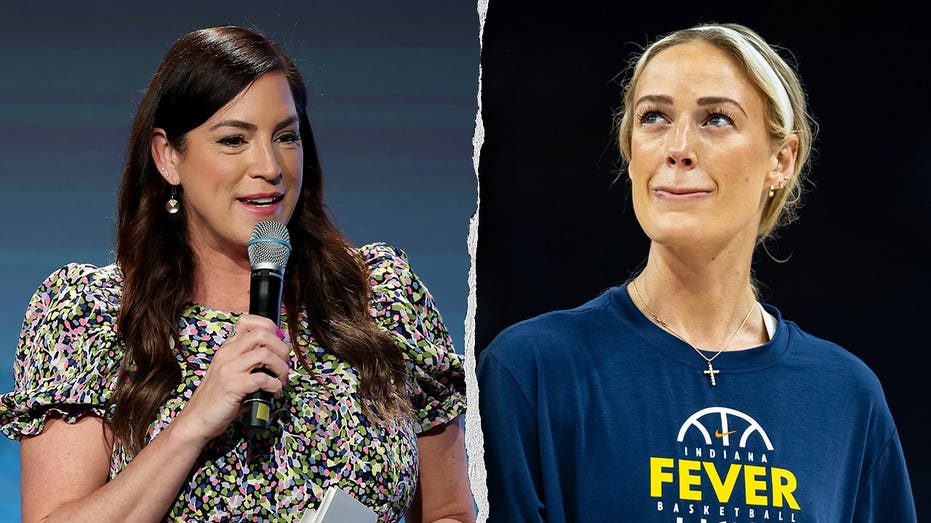
Sarah Spain wants everyone to know that she champions women.
She often refers to the NBA as the "MNBA," an incredibly performative way to make sure listeners understand that the WNBA isn’t some secondary league just because it has a "W" in front of it.
But listen to Spain talk about actual women, particularly women who disagree with her politically, and that supposed respect disappears rather quickly.
WNBA MEDIA PREDICTABLY EMBARRASSES ITSELF AGAIN BY IGNORING SOPHIE CUNNINGHAM STORY OVER ALL-STAR WEEKEND
Spain used a recent episode of her "Good Game" podcast to launch one of the most disgusting personal attacks I’ve heard against Indiana Fever guard Sophie Cunningham. She didn’t simply disagree with Cunningham’s position on males competing in women’s sports. Spain attacked Cunningham’s character, motives, upbringing, family, friends and ability to care about anyone other than herself.
The best part? Spain’s own evidence completely contradicted her conclusion.
Spain read directly from a recent ESPN profile in which Cunningham explained why she opposes allowing biological males to compete against girls and enter their locker rooms.
"I think that I am here to extend love, but I also think that with love is truth, being honest, and I want to protect young girls in a locker room, or young girls in sport, who shouldn’t have to go against biological men," Cunningham said.
Seems fairly clear, right?
Cunningham wasn’t talking about protecting her own WNBA roster spot. She wasn’t complaining about having to compete against a male herself. She was expressing concern for young girls who have far less power, influence and ability to speak publicly than she does.
Spain somehow reached the exact opposite conclusion.
"It just seems like she doesn’t have any interest in empathizing or caring about anyone but Sophie," Spain said.
Did she listen to the quote she had just read?
Spain didn’t deliver the segment in a measured or analytical tone. Her voice dripped with contempt as she portrayed Cunningham as selfish, uncaring and the product of a family that encouraged her to make everything about herself.
"Cunningham has been emboldened throughout her life by family and supporters to be the center of her own story," Spain said.
This wasn’t simply a disagreement over transgender athletes. Spain was attacking Cunningham’s character and attempting to explain how the people closest to her had supposedly helped shape it.
Then Spain described Cunningham’s comments about protecting girls as "filled with offensive language" and "entirely lacking nuance or care."
Spain called Cunningham’s statement "filled with offensive language."
But what exactly was offensive?
Cunningham said she wanted to "extend love," speak the "truth," be "honest" and "protect young girls."
Yet, Spain used that statement as proof Cunningham lacks empathy.
Come on.
Cunningham’s quote was explicitly about other people. Spain’s accusation wasn’t merely unsupported. It was disproven by the quote Spain had just read.
Then Spain’s attack turned much darker.
Spain accused Cunningham of failing to discuss harassment directed toward other WNBA players and said, "She complains of stalkers, for instance."
"Complains."
Spain made it sound as though Cunningham were whining about nasty replies on social media or someone criticizing her basketball ability. That's an incredible minimization of what Cunningham actually faced.
An Indianapolis man was charged with felony stalking and intimidation, along with misdemeanor harassment, after prosecutors alleged that he targeted Cunningham over an extended period. The charges are allegations, and the man has not been convicted in the case.
According to court filings reviewed by OutKick and Fox News Digital, the man allegedly hand-delivered a package for Cunningham to Gainbridge Fieldhouse. Investigators said an account tied to him posted sexually explicit messages and references to his physical proximity to Cunningham, including a message stating, "You’re literally down the street from me!"
INDIANAPOLIS MAN CHARGED WITH ALLEGED STALKING OF INDIANA FEVER'S SOPHIE CUNNINGHAM, THREATENING SECURITY EXEC.
Cunningham told investigators that the continued posts caused her to stay home more often and suffer nightmares. She said she felt as though she constantly had to watch her back, didn’t feel safe and feared the man. Prosecutors said the conduct continued after Pacers Sports & Entertainment sent him a cease-and-desist letter and banned him from team properties and events.
The situation was so serious that the man was also accused of threatening John Ball, the Pacers security executive who intervened. One alleged message stated, "Pain is coming. I promise." Ball told investigators that the man referenced his wife and the county where he lived, causing him to alter his routine, begin carrying a firearm and request additional police patrols near his home.
That’s what Spain reduced to Cunningham "complaining."
And Spain didn’t mention the stalking because she felt sympathy for Cunningham. She used Cunningham’s terrifying experience as another piece of evidence against her. Apparently, Cunningham failed Spain’s test because she didn’t use her own documented stalking ordeal to center harassment directed at other WNBA players, particularly Black and queer players.
White players are expected to answer for every threat, insult or injustice involving Black players. But when Caitlin Clark or Sophie Cunningham is targeted, the conversation quickly becomes what those women have supposedly failed to do for someone else.
Spain didn’t forget that Cunningham had been stalked. She mentioned it herself.
She simply decided Cunningham wasn’t the kind of woman whose fear deserved empathy.
Later in the same episode, Spain made women’s fear and safety the foundation of an entirely different argument.
Spain and ESPN reporter Holly Rowe discussed whether WNBA Commissioner Cathy Engelbert should personally provide more emotional support to players who receive harassment or threatening messages.
Rowe offered a fair solution: The league could employ a former player or dedicated player-relations official who knows the athletes, communicates with them directly and provides support when needed.
"I don’t necessarily know that it needs to come from the commissioner’s office," Rowe said. "I feel like Cathy should be worried about business, right?"
Spain initially claimed to agree. Then she argued that the WNBA commissioner may need to have a fundamentally different job than commissioners in other major professional leagues.
"I think in men’s sports, you would not expect the commissioner to have that necessarily direct line to the players," Spain said. "I do think maybe there’s an argument that this league needs it."
Spain suggested that Engelbert could become the CEO or president, while a former player could become "more the commissioner type" and handle the emotional relationships with players.
So, Spain’s position appears to be that male professional athletes can have a commissioner whose job is to run the business, represent ownership and absorb criticism. Female professionals, however, may require the title of commissioner to belong to someone whose primary role is tending more directly to the players’ emotions.
That's incredibly condescending.
A women’s league can and should have security officials, mental-health resources and player-relations employees. But the commissioner of a women’s professional sports league shouldn’t have a fundamentally different job simply because she's a woman or because the athletes are women.
Apparently, Spain believes adding an "M" to the NBA is equality. Treating female athletes like equally capable professionals is another matter.
And, for the record, calling it the "MNBA" isn’t merely silly. It’s factually incorrect because the NBA isn’t a male-only league.
Ann Meyers signed with the Indiana Pacers in 1979 and became the first woman to receive an NBA tryout. The league’s current collective bargaining agreement defines a player contract as an agreement between a "person" and a team.
A woman good enough to earn a roster spot with the New York Knicks would be eligible to play for the New York Knicks. The NBA is already the NBA. It doesn’t need Spain’s performative rebranding.
Spain apparently knew listeners might hear Rowe’s argument and conclude that Rowe was right.
Before playing the interview, Spain inserted a scripted clarification. She said she wanted to explain a point that she wasn’t sure "gets out fully in our convo."
Spain bundled trolling, racial and homophobic slurs, harassment and threats into one broad category. She argued that those issues make up an "outsized portion" of the conversation surrounding the WNBA, unlike in men’s sports.
"And that’s why I think the commissioner and the league have a different responsibility when it comes to addressing and communicating with the players about it," Spain said.
This wasn’t an off-the-cuff comment that came out poorly during a live discussion. Spain heard the interview, had time to reconsider her position, wrote a clarification and recorded it for listeners.
Given all that time, she doubled down.
That makes the Cunningham hypocrisy even more appalling. Less than half an hour after dismissing a real and extensively documented stalking case as something Cunningham "complains" about, Spain argued that women experience threats so differently that leaders of women’s sports require a different job description.
You couldn’t create a clearer double standard if you tried.
When the woman was Sophie Cunningham, Spain treated a stalking case involving criminal charges, sexually explicit messages, physical proximity and threats against security personnel as an annoyance.
When Spain discussed alleged online harassment involving players who better fit her racial and ideological narrative, female vulnerability suddenly became so important that the WNBA needed an entirely different kind of commissioner.
The facts didn’t determine Spain’s level of empathy.
The identity and politics of the woman did.
What makes the exchange with Rowe so compelling is that Rowe isn’t some conservative critic of Spain or the WNBA.
Quite the opposite.
During the same conversation, Rowe argued that society constantly tries to tear women down. She blamed much of the WNBA’s online toxicity on misogyny, called the league celebratory and inclusive and proudly noted that "the WNBA helped flip the Senate in this country."
She also accused critics of not wanting WNBA players to be "strong and powerful and connected and unified."
WNBA SUDDENLY WANTS TO STICK TO BASKETBALL AFTER YEARS OF MAKING POLITICS PART OF THE PRODUCT
So, this wasn’t an argument between two people with opposing worldviews. Rowe accepts nearly all of Spain’s progressive premises about women, misogyny and the WNBA.
She still thought Spain’s conclusion was sexist.
Rowe asked whether Roger Goodell is paid to absorb criticism directed at the NFL.
Spain responded, "One thousand percent."
"That is his job," Rowe replied. "So, what’s wrong with that?"
Spain then questioned whether the WNBA commissioner’s job is different because of "the intersectionality of women’s sports," the relationship between female players and leadership and the negative coverage surrounding the league.
Rowe pushed back that athletes in the NBA and NFL receive similar abuse, some of which is likely related to gambling rather than racism, homophobia or misogyny. Spain continued insisting that the WNBA was different.
"That’s why I think right now, at this moment in time, leadership in the WNBA has more of a responsibility for that than on the men’s side," Spain said.
Rowe forcefully rejected the argument.
"That’s so sexist," Rowe said. "Like, why? Why can’t we be just like the men? I just find that so problematic."
Rowe wasn’t joking. She wasn’t teasing Spain or engaging in friendly banter. She adamantly rejected the premise that a female commissioner should have a different job because she’s a woman overseeing female athletes.
And she was right.
Caught flat-footed by Rowe’s response, Spain pivoted from the commissioner’s job to women’s safety more broadly.
Spain said threats affect men and women differently because male athletes have more money and security.
"Flat out, it is more dangerous for women, and they feel more endangered when they get threats than men do, especially men in multimillion-dollar mansions with tons of security," Spain said.
Rowe came prepared with an obvious counterexample. She cited Philadelphia Eagles star Saquon Barkley, whose home had just been invaded while he and his family were inside. Police said the break-in occurred early Saturday while Barkley’s home was occupied; Barkley and his family were not physically harmed.
Apparently, the multimillion-dollar mansion didn’t create an invisible force field.
More importantly, Spain had changed the subject. They weren’t debating whether men and women always experience danger identically. They were discussing whether those differences require a female commissioner to perform a different, more nurturing job.
Rowe recognized the pivot immediately.
"That’s a whole different conversation," Rowe said. "That’s not actually what we were even talking about."
Rowe then worried that people would clip the exchange and misrepresent her argument. So, let’s be perfectly clear.
Rowe wasn’t saying women never experience misogyny, harassment or distinct safety concerns. She was saying those concerns don’t change the fundamental job of a professional sports commissioner.
That context doesn’t weaken Rowe’s criticism.
It makes it stronger.
Spain’s entire argument hinges on men and women being fundamentally different.
She argues that women experience danger differently, feel more endangered by threats and require a different relationship with league leadership. In her telling, the differences are significant enough to reconsider how an entire professional sports league should be structured.
But when Cunningham says biological differences matter in athletic competition and intimate locker rooms, Spain calls the statement offensive and devoid of care.
So, sex matters enough to justify a different job description for the commissioner of a women’s league, but not enough to preserve women’s sports and locker rooms for women.
You can’t have this both ways.
Spain treats sex as critically important when it allows her to portray women as vulnerable. Then she treats it as subordinate to gender identity when girls ask for fair competition and privacy.
That isn’t a coherent principle. It’s an ideological convenience.
And it leads directly back to Sophie Cunningham.
Spain read Cunningham expressing concern for young girls and called her selfish. She mentioned Cunningham’s documented stalking ordeal and used it against her. Then she spent the rest of the episode explaining how deeply women are affected by threats and why they require greater protection.
Spain claims to champion women, but her empathy seems entirely dependent on whether the woman agrees with Sarah Spain.
That isn’t feminism.
It’s hypocrisy, and it’s disgusting.