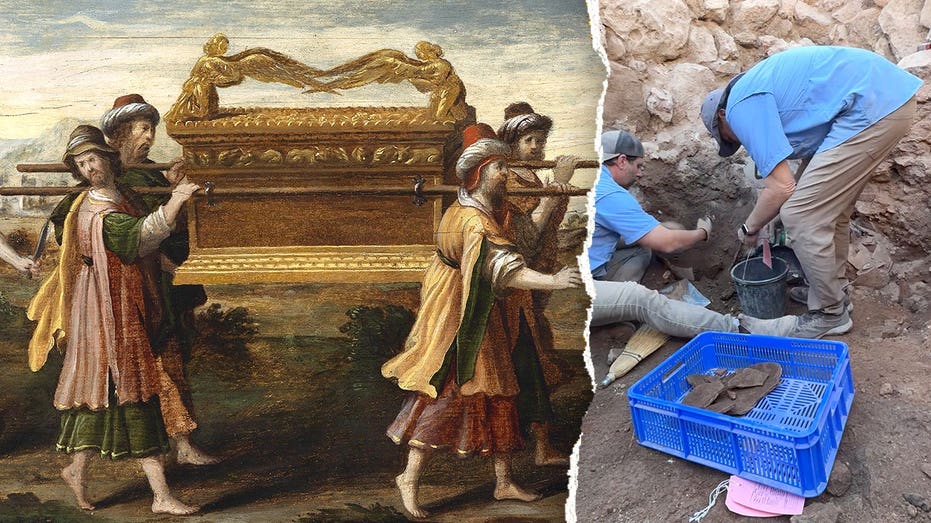
Archaeologists recently uncovered ancient food remains at biblical Shiloh, the ancient site where the Bible says the Ark of the Covenant was housed for centuries.
The remains were found at Tel Shiloh, an archaeological site in the West Bank that is traditionally identified as biblical Shiloh, where the Ark of the Covenant was kept before it was taken by the Philistines.
The discovery was made beneath an Israelite-period ritual deposit and adjacent to an ancient Canaanite fortification wall, according to the excavation team.
'SIGNIFICANT' EARLY CHRISTIAN CHURCH EMERGES BENEATH FORMER FISH MARKET IN ANCIENT CITY
Two of the jars contained olives, while a third held lentils, according to archaeobotanical analysis — and one of the vessels contained some 500 burned olive pits.
The olives in the jar were likely preserved in oil before they were burned thousands of years ago, said Scott Stripling, excavation director and the president of the Near East Archaeological Society.
Stripling, who is based in Texas, told Fox News Digital that "some sort of accident" likely started a fire — and ended up preserving the olives for thousands of years.
"Once it started on fire, then it caught that whole area on fire," he said. "That's what it appears to me. But next year we'll have to excavate a broader area to better understand exactly what it was."
ARCHAEOLOGISTS UNEARTH ANCIENT TREASURE CACHE AT BIBLICAL CITY CONNECTED TO GENESIS
Before reaching the jars, archaeologists excavated an Israelite-period ritual deposit containing roughly 10,000 animal bones, pottery vessels and eight gold and silver objects, including pendants and earrings, Stripling said.
The deposit was not an ordinary garbage pit, he said — but a favissa, where the remains of sacrificial offerings were deliberately buried rather than discarded with everyday waste.
"We went through about two meters [6.6 feet] of heavy sort of tumble, and then we came down on these storage jars," he said.
"At the top, we could see the rims. So we were very careful not to remove any pieces of it, and to keep going down deeper and wider so that we could leave them intact."
CLICK HERE TO SIGN UP FOR OUR LIFESTYLE NEWSLETTER
Eventually, the team made so much progress that it needed ladders to enter and exit the excavation trench.
Though the scale of the olive pits was surprising, the types of food were not. Stripling described the lentils and olives as "staples of the Mediterranean diet."
Stripling said the Israelites who later occupied Shiloh likely had no idea that much older Canaanite storage jars lay buried beneath the ritual deposit they created.
"For thousands of years, the Israelites who deposited the remains of the sacrificial system above the jars didn't even know they were there," Stripling said.
CLICK HERE FOR MORE LIFESTYLE NEWS
He added that the jars are being restored at Tel Aviv University, where researchers hope to learn more about the artifacts.
TEST YOURSELF WITH OUR LATEST LIFESTYLE QUIZ
"I will be shocked if the radiocarbon dates do not come back as Middle Bronze Age," he said. "These [burned olive pits] are ideal for radiocarbon dating."
Stripling said the team also plans to expand excavations next year to determine whether the jars were stored in a kitchen, storage room or another part of the ancient settlement.
"These jars have been buried there waiting for us to find them," he said.